Reclaimed wood furniture, built from timber with a past.
Dense, fully-seasoned old-growth hardwood — salvaged, re-sawn and re-milled into furniture that carries genuine age and grain. Manufactured in Jodhpur, documented for EU and US import, and shipped by the container.

Timber that has already lived a long life.
Reclaimed wood — sometimes called old wood or salvaged wood — is solid timber recovered from structures and stock that have reached the end of their first use: demolished buildings, old doors and window frames, roof beams and joists, decommissioned boats, factory floors and railway sleepers. Rather than being felled fresh, the wood is sorted, de-nailed, cleaned, re-sawn, kiln-dried to export moisture levels and re-milled into furniture-grade boards.
The base species vary with the source, but reclaimed stock in India is typically old teak, sheesham (Indian rosewood), acacia and mixed tropical hardwoods — woods that were slow-grown and dense to begin with. Decades of seasoning mean the timber has already done most of its moving, splitting and settling, which is exactly why cabinetmakers prize it. What you buy is character that cannot be faked: nail holes, saw marks, bolt scars, weathered patina and deep, closed grain, each piece genuinely one of a kind.
How reclaimed wood behaves — and why specifiers choose it.
A quick-reference profile for buyers, designers and merchandisers evaluating reclaimed wood against freshly-sawn solid timber.
| Attribute | Reclaimed wood |
|---|---|
| Origin | Salvaged from old buildings, beams, doors, boats, flooring and railway sleepers — reprocessed, not freshly felled |
| Base species | Varies by source — commonly old teak, sheesham, acacia and mixed tropical hardwoods |
| Density & hardness | Generally high — slow-grown old-growth timber; hard-wearing, resists dents and daily use |
| Grain & character | Pronounced, weathered; patina, saw and nail marks, colour variation — every board unique |
| Moisture stability | Excellent — decades-seasoned, then re-kiln-dried to export levels; low tendency to warp or move |
| Durability | Suited to heavy-use furniture — dining, bar, reception, hospitality and contract interiors |
| Sustainability | Reuses existing timber — no new tree felled; deforestation-free story for eco-led ranges |
| Finishes | Natural oil, matt or satin lacquer, wax, light whitewash or stain; CARB / TSCA-compliant low-emission options |
| Best uses | Industrial wood-and-iron pieces, dining and console tables, sideboards, bar and retail fixtures, statement décor |
Figures describe typical behaviour of reclaimed hardwood stock; exact density, hardness and tone depend on the salvaged species. We confirm the material profile of each production batch on request.
Where reclaimed wood wins — and what to plan for.
Why buyers specify it
Authentic age and patina that distressing can't replicate · dense, stable old-growth timber · a genuine deforestation-free, reuse-led sustainability story · premium shelf and project appeal · pairs naturally with wrought iron for the industrial look that sells.
What to plan for
Supply is finite and board-by-board variable, so exact colour and sizing are managed by grading and sample approval, not guaranteed identical · lead times reflect sorting and preparation · heavy dense pieces favour knockdown / flat-pack construction to control freight and breakage.
Prefer a uniform, repeatable look at higher volume? Mango wood and acacia offer consistent grain and tone; sheesham delivers hardwood durability with rich figure. We help you match material to channel across the full solid-wood range.
A reuse story your compliance team can actually document.
Reclaimed wood is one of the strongest sustainability claims in furniture — but only if the paperwork holds up at the port. We treat reclaimed lines the same way we treat freshly-sawn timber: documented, traceable and import-ready.
That means FSC chain-of-custody where applicable, Vriksh timber-legality verification, and EUDR-ready due diligence with geolocation and deforestation-free declarations. We support US Lacey Act declarations, UK Timber Regulation (UKTR), CARB / TSCA Title VI formaldehyde-compliant finishes and ISPM-15 heat-treated export packing. CITES-compliant handling applies to any sheesham (Dalbergia sissoo) in the mix.
| Requirement | Our standard |
|---|---|
| Timber legality | Vriksh verified · CITES-compliant sheesham |
| Sustainability | Reclaimed / reuse-led · FSC chain-of-custody |
| EU market | EUDR-ready · geolocation · UKTR |
| US market | Lacey Act support · CARB / TSCA finishes |
| Social audit | SEDEX / SMETA · ISO · SGS inspection |
| Export packing | ISPM-15 heat-treated · flat-pack options |
Finished to sell, easy to keep.
Finish options
Natural oil and wax to keep the raw, aged feel; matt or satin lacquer for a sealed commercial surface; light whitewash or stain to even out tone. Low-emission, CARB / TSCA-compliant systems available for the US and EU.
Everyday care
Dust with a soft dry cloth and wipe spills promptly; avoid soaking and harsh solvents. Keep away from direct heat and prolonged direct sun. Oiled surfaces can be re-oiled periodically; lacquered surfaces need only gentle cleaning.
Built for shipping
Dense reclaimed pieces travel best as knockdown / flat-pack — lower freight, denser loading and less transit damage — or fully assembled where the design demands. All export-packed to ISPM-15.
From industrial dining ranges to statement retail fixtures.
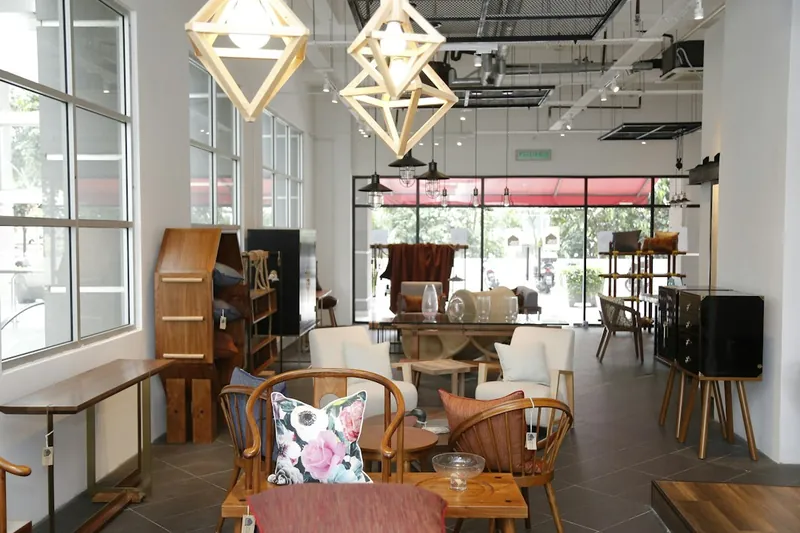
Furniture ranges
Dining and console tables, sideboards, cabinets and wood-and-iron industrial pieces built on a solid reclaimed-timber heart.
Explore the furniture range
Décor & accessories
Trays, bowls, candle holders, frames and shelving — high-margin reclaimed pieces to fill and finish a container.
Explore décor and accessoriesPrivate label & OEM
Your design, finish, brand and packaging — reclaimed collections produced to spec with custom CNC and sample approval.
Private-label manufacturingBuyer questions, answered.
What is reclaimed wood furniture made from?
Reclaimed wood furniture is built from solid timber salvaged and reprocessed from old structures and used stock — commonly old teak, sheesham, acacia and mixed hardwoods recovered from demolished buildings, doors, beams, boats and railway sleepers. The boards are cleaned, de-nailed, re-sawn, kiln-dried and re-milled into furniture-grade stock, so each piece carries genuine age, patina and grain rather than a printed or distressed finish.
Is reclaimed wood furniture durable enough for commercial and hospitality use?
Yes. Most reclaimed stock is dense, slow-grown old-growth hardwood that has already fully seasoned and moved over decades, so it is dimensionally stable and hard-wearing. Re-kiln-drying to export moisture levels and solid-timber joinery make it well suited to dining tables, bar tops, reception desks and hotel and restaurant interiors. We QC every piece and can specify commercial-grade finishes on request.
Is reclaimed wood a sustainable, deforestation-free choice?
Reclaimed wood reuses timber that already exists, so no new tree is felled for the board — it keeps usable hardwood out of waste streams and reduces pressure on forests. We document the chain for import markets with FSC chain-of-custody where applicable, Vriksh timber-legality verification, and EUDR-ready due diligence, and we support US Lacey Act declarations and UK Timber Regulation requirements.
Can colour, finish and sizing be matched across a reclaimed wood order?
Because reclaimed timber is naturally varied, no two boards are identical — that character is the point. We manage it with grading, controlled blending and sample approval so a batch reads as one coherent collection. We produce to your drawings and finishes (OEM) or from our own designs (ODM), with custom CNC work and retail-ready or branded packaging, and we approve a physical sample before bulk production.
What are the order terms for reclaimed wood furniture?
A trial or sample order can ship LCL (part-container). For best wholesale pricing thereafter, our standard minimum is one 20ft full container load, and we consolidate reclaimed furniture with décor and metalware into mixed containers. Typical lead time is 30–45 days. We ship FOB or CIF from Mundra or Nhava Sheva, in flat-pack or assembled form, with ISPM-15 heat-treated export packing.
Put genuine reclaimed character on your shelves — fully documented.
Send us your drawings, references or target range. We quote FOB or CIF with MOQs and lead times, produce a sample for approval, and ship import-ready reclaimed furniture by the container.