Cane & rattan furniture — hand-woven on solid-wood frames, built for export.
Natural rattan poles and hand-woven cane, worked onto kiln-dried sheesham, mango and acacia frames. The warmth and breathability buyers love, with the structure, compliance and container-readiness a serious import programme needs.

What cane and rattan actually are.
The words are used loosely in the trade, so buyers specifying a range should know exactly what they are ordering. Getting the terminology right keeps your tech packs, listings and customer expectations aligned.
Rattan
The solid, jointed stem of a fast-growing climbing palm (genus Calamus and relatives), native to the tropical forests of South-East Asia. It is the structural raw material — bent into frames, arms and legs when steamed, and split into poles and reeds.
Cane
The thin, glossy outer skin peeled from the rattan stem. Cane is what forms the familiar woven webbing — open, hexagonal "French cane" and closed weaves — seen on chair backs, bed heads and cabinet fronts.
Wicker
Not a material but a technique: the craft of weaving. Wicker can be worked in natural rattan and cane, or in seagrass, jute and weather-resistant synthetic (PE) fibre for outdoor use.
Why designers and importers specify rattan.
Rattan is one of the world's most renewable furniture fibres — light, remarkably strong for its weight, and endlessly workable. Here is how it behaves as a material, so you can position it accurately for your market.
| Attribute | Natural cane & rattan |
|---|---|
| Origin | Climbing rattan palm, tropical South-East Asia; a non-timber forest product |
| Weight | Very light — ideal for movable seating and lower freight weight |
| Strength | High tensile strength and flexibility for its weight; bends without splitting when steamed |
| Grain & look | Warm honey tone, visible nodes on poles, fine even grain on cane webbing |
| Breathability | Open weave allows airflow — comfortable in warm climates and humid rooms |
| Renewability | Matures in a few years, far faster than hardwood timber; regrows from the same plant |
| Best environment | Indoor or covered / shaded settings; protect from direct rain and prolonged sun |
| Typical finishes | Natural, honey, cognac, black, white-wash and tinted lacquers |
Because natural fibre alone cannot carry heavy static loads indefinitely, we never build seating from weave alone. Every piece is engineered on a kiln-dried solid-wood frame — the timber carries the load, the rattan and cane carry the look.
A complete woven range, framed in solid wood.
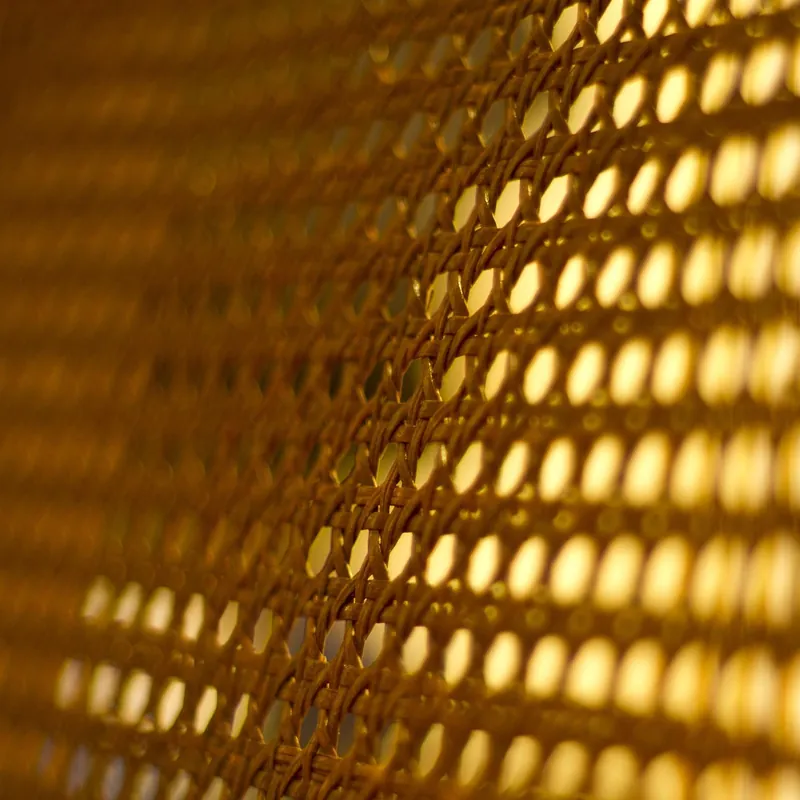
Seating & chairs
Cane-back dining chairs, accent and lounge chairs, bar stools and benches on sheesham or mango frames.
Explore woven seating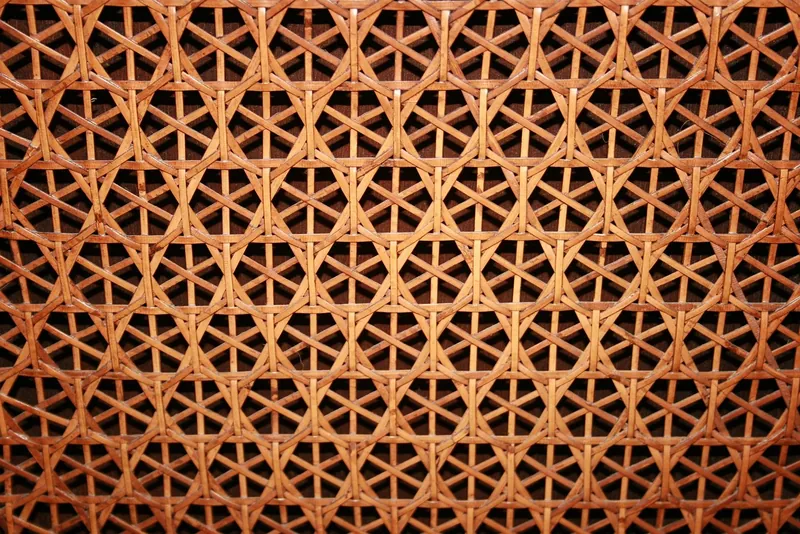
Cane-front storage
Sideboards, cabinets, bedside tables and dressers with woven cane door and drawer panels.
Explore cane storage
Beds & headboards
Woven cane and rattan bed heads, four-posters and bedroom suites for boutique hotels and retail.
Explore woven bedroomWe also weave mirrors, room dividers, trays, lanterns, pendant shades and peacock-style chairs — the high-margin, container-filling pieces that pair naturally with our décor & accessories range for mixed-category loads.
How to keep a woven range selling for years.
Well-made cane and rattan ages gracefully. Share this with your customers and your returns stay low.
- Keep it indoors or shaded. Direct sun fades the fibre; soaking rain and radiators dry it out and make it brittle.
- Dust the weave. A soft brush or vacuum nozzle clears the open panels; a barely-damp cloth for the frame.
- Restore the spring. If cane webbing slackens over years, a light mist on the underside and air-drying tightens it again.
- Reinforce for contract use. For hospitality we double-weave high-wear panels, reinforce joints and specify harder lacquers.
Specify the right fibre for the setting.
| Consideration | Natural rattan / cane | Synthetic (PE) weave |
|---|---|---|
| Best use | Indoor & covered | Open-air & poolside |
| Look | Authentic, warm, premium | Rattan-look, uniform |
| Weather | Protect from rain & sun | UV & water resistant |
| Sustainability | Renewable natural fibre | Durable, recyclable polymer |
| Frame | Solid wood | Solid wood or powder-coated metal |
We build the same silhouettes in either fibre, so a single collection can run both an indoor natural line and an outdoor synthetic line.
A renewable fibre, on a fully documented frame.
Rattan is a non-timber forest product that matures in a few years and regrows from the same plant — one of the most renewable furniture materials available, and a credible solid-wood alternative for buyers diversifying their sourcing. The solid-wood frame beneath each piece is where timber legality applies, and that is where our paperwork does the work.
| Area | Our standard |
|---|---|
| Frame timber legality | Vriksh verified · CITES-compliant sheesham |
| Frame sustainability | FSC chain-of-custody · reclaimed options |
| EU market | EUDR-ready · geolocation · UKTR |
| US market | Lacey Act support · CARB / TSCA finishes |
| Social audit | SEDEX / SMETA · ISO · SGS inspection |
| Export packing | ISPM-15 heat-treated · flat-pack options |
The honest case for a woven range.
Why it sells
- On-trend, warm, premium look across coastal, boho and modern-organic ranges.
- Light weight lowers shipping weight and makes pieces easy to merchandise and move.
- Renewable, fast-growing fibre — a strong sustainability story for your listings.
- Breathable and comfortable; pairs with any solid-wood or metal collection.
What to plan for
- Natural fibre is for indoor / covered use — specify synthetic weave for open-air projects.
- Load must be carried by the frame, so build quality of the wood matters most.
- Hand-weaving is labour-intensive; plan the 30–45 day lead time into your buy.
- Keep away from direct heat and standing water to protect the weave long-term.
Cane & rattan, answered.
What is the difference between cane, rattan and wicker?
Rattan is the solid stem of a climbing palm — the raw material. Cane is the thin, glossy outer skin peeled from that stem and used for the woven webbing you see on chair backs and cabinet doors. Wicker is not a material at all; it is the weaving technique, which can be done in rattan, cane, seagrass or synthetic fibre. Our pieces use natural rattan poles for the structure and hand-woven cane for panels, on a solid-wood frame.
Is cane and rattan furniture strong enough for hotels and restaurants?
Yes, when it is built correctly. We frame our rattan furniture on kiln-dried solid wood — sheesham, mango or acacia — so the load is carried by the timber, not the weave. The rattan and cane provide the surface, breathability and look. For heavy contract use we reinforce joints, double-weave high-wear panels and finish with hard-wearing, CARB/TSCA-compliant lacquers.
Can natural rattan furniture be used outdoors?
Natural rattan and cane are best suited to indoor or fully covered, shaded settings — verandas, conservatories, lobbies and poolside shade — where they are protected from direct rain and prolonged sun. Unprotected natural fibre will dry out and fade outdoors. For open-air projects we build the same designs with weather-resistant synthetic (PE) weave on powder-coated or solid-wood frames.
Do you make cane and rattan furniture to our own designs and private label?
Yes. We work as both ODM, supplying our own catalogue of woven designs, and OEM, manufacturing to your drawings, dimensions, weave pattern, finish and private-label or retail-ready packaging. Custom CNC-cut frames, bespoke weave densities and branded packaging are all available.
What is the minimum order and lead time for rattan furniture?
A trial or sample order can ship LCL (part-container). For best wholesale pricing, one 20ft full container load is our standard minimum thereafter, and we consolidate rattan pieces with other furniture and décor in one mixed container. Typical lead time is 30–45 days; urgent orders are possible at a premium.
How is woven cane and rattan furniture packed for export?
Larger pieces are built as knockdown / flat-pack where the design allows, which protects the weave and maximises container density. Assembled pieces are corner-protected and shock-packed. All solid-wood frames use ISPM-15 heat-treated export packaging, and we offer branded, retail-ready and Amazon-FBA-ready cartons.
Bring us your coastal, boho or modern-organic collection.
Send a reference, a drawing or a mood — we will sample it in natural cane or synthetic weave on a compliant solid-wood frame, quote FOB or CIF from Mundra / Nhava Sheva, and ship from a trial order up to repeat containers.